


Every school that rethinks student phone use eventually arrives at the same hard truth: the issue is rarely the device alone. It is the constant negotiation around it. Teachers lose instructional time repeating the same reminders, administrators inherit avoidable conflicts, and students receive a mixed message about attention, boundaries, and accountability. A Safe Pouch approach becomes appealing not because it sounds strict, but because it offers a practical structure. When the process is well designed, the school day feels less like a contest over screen access and more like a return to clear expectations.
The turning point: when phone use becomes a schoolwide problem
In many schools, the decision to adopt Safe Pouch does not begin with a dramatic incident. More often, it grows from a pattern that staff can no longer ignore. Phones interrupt direct instruction, distract during independent work, surface during transitions, and complicate social issues far beyond the classroom. Even where a phone policy already exists, uneven enforcement often weakens it. One teacher confiscates devices. Another allows them for convenience. A third simply gives up. The result is inconsistency, and students quickly learn how to navigate that inconsistency.
A school considering Safe Pouch is usually looking for more than a ban. It is looking for a system. That distinction matters. Traditional collection methods can create logistical strain, liability concerns, and bottlenecks at the start and end of the day. By contrast, a decentralized pouch model places responsibility closer to the student while still protecting instructional time. That is one reason school leaders reviewing practical options often consider Safe Pouch from Win Elements when they want a decentralized phone ban that can be enforced without turning every classroom into a checkpoint.
At this stage, the most effective leadership teams avoid framing the issue as a war on technology. They define it as an attention and culture issue. That shift helps families and staff understand the goal: fewer distractions, more consistent routines, and a school environment where device access does not dominate every interaction.
Why Safe Pouch works best when policy and culture are aligned
Adopting Safe Pouch is not simply a purchasing decision. It is a policy decision, a culture decision, and an operations decision. Schools that implement it successfully usually begin by answering a few foundational questions before launch. Will the pouch be used throughout the full school day or only in certain periods? What are the procedures for late arrivals, early dismissals, and extracurricular activities? How will medical or documented accommodation needs be handled? What happens when a student refuses to comply?
Clarity at the outset prevents the system from becoming vulnerable to ad hoc exceptions. Students accept structure more readily when they can see that it is coherent. Staff support it more readily when they know they will not be left to improvise enforcement alone. Families are more likely to cooperate when they understand how communication will work during the day and how emergencies will be handled through established school channels.
Safe Pouch is especially useful in this context because it supports a visible, repeatable routine. The phone is not hidden in a backpack where enforcement depends on suspicion. It is placed in a defined system that removes casual access while allowing the school to avoid large-scale collection and storage. That balance is often what makes the model workable in real educational settings.
Preparing the rollout: staff training, parent communication, and student expectations
The schools most likely to sustain a Safe Pouch policy treat rollout as a change-management process. They do not announce it on Friday and expect smooth compliance on Monday. Instead, they prepare the community. Staff need a common script. Students need to know what is changing and why. Families need enough notice to ask practical questions before the first day of implementation.
A strong rollout usually includes a straightforward sequence:
- Leadership alignment. Senior leaders, year-level heads, and classroom staff agree on the exact procedures.
- Written guidance. The school issues a concise policy document explaining expectations, consequences, and exceptions.
- Family communication. Parents and guardians receive advance notice focused on learning, wellbeing, and consistency.
- Student orientation. Students are shown how the pouch system works and what daily compliance looks like.
- Visible first-week support. Staff presence during arrival, transitions, and dismissal helps normalize the routine quickly.
It also helps to define responsibilities by role rather than assuming everyone will interpret the policy the same way.
| Role | Primary responsibility during rollout | What success looks like |
|---|---|---|
| School leadership | Set policy, approve exceptions, and back staff publicly | Clear messaging and visible consistency |
| Teachers | Reinforce the routine without debate or improvisation | Calm classroom starts and fewer repeated reminders |
| Student services or pastoral teams | Support compliance issues and family concerns | Problems handled early before they become recurring conflict |
| Parents and guardians | Understand communication channels during the school day | Less pressure on students to check phones during class hours |
| Students | Follow the routine from arrival to dismissal | The pouch becomes part of the normal school day |
This preparation phase is where schools either build trust or erode it. If the message is clear, calm, and uniform, Safe Pouch is more likely to be accepted as a routine. If the message is inconsistent, it can be perceived as punitive before it has a chance to prove its value.
The first weeks of implementation: what schools learn quickly
The early stage of a Safe Pouch rollout tends to reveal less about student resistance than about adult consistency. Most students adapt faster than expected when expectations are stable. The larger challenge is making sure every teacher, administrator, and support staff member responds the same way when a phone appears outside the agreed process.
In practical terms, the first weeks are about reducing friction. Arrival routines need to be smooth. Staff need to avoid lengthy arguments over compliance. Consequences need to be predictable rather than emotional. A well-run implementation does not depend on dramatic discipline. It depends on repetition. Once the pouch becomes part of the rhythm of the day, enforcement becomes less theatrical and more procedural.
Schools also learn that communication matters after launch, not just before it. Families may need reminders about how to reach students through the front office. Students may test boundaries around breaks, bathrooms, or end-of-day transitions. Staff may identify edge cases that require refinement. None of this indicates failure. It indicates that the school is moving from policy theory to policy practice.
What often changes first is the texture of the school day. Teachers spend less time negotiating over visible phone use. Students have fewer opportunities for impulsive checking during lessons. Conversations become more present. The gain is not only academic. It is relational. A calmer classroom usually gives teachers more space to teach and students more space to engage.
Conclusion: the real lesson from a Safe Pouch journey
The most important lesson in any Safe Pouch journey is that schools do not need a perfect system; they need a workable one that people will actually follow. A phone policy fails when it depends on constant confrontation or individual teacher stamina. It succeeds when expectations are visible, routines are simple, and the burden of enforcement is shared across the school community.
Safe Pouch offers value because it turns a daily source of friction into an operational routine. For schools that want to protect learning time without creating unnecessary logistical strain, that is a meaningful advantage. The real win is not just fewer phones in sight. It is a more focused school environment, a clearer standard for students, and a staff culture that no longer has to negotiate attention one lesson at a time.
——————-
Check out more on Safe Pouch contact us anytime: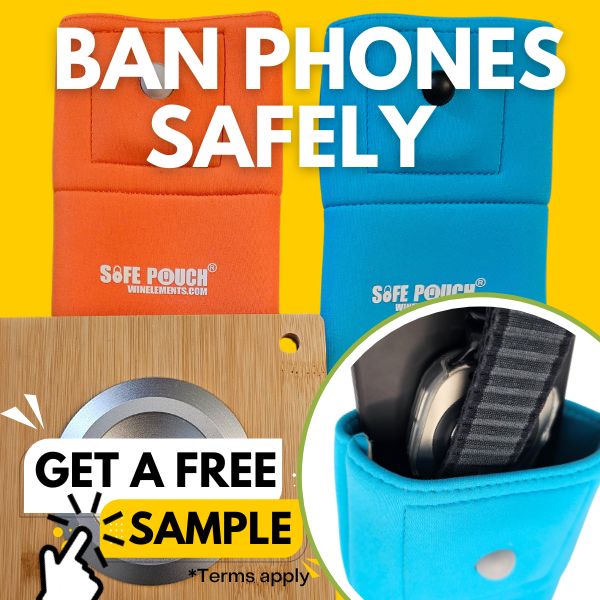
Win Elements | Lockable Phone Pouch
https://www.winelements.com/
Patented lockable phone pouches with multi-tiered lockers for phone locking pouches.
